
This article was originally published by UNA-UK.
On 30 June parliamentarians, diplomats, journalists, academics and civil society representatives came together to discuss one of the most pressing challenges facing international security: the rapid development of artificial intelligence (AI) and autonomous weapons systems (AWS). The roundtable, co-hosted by the APPG on Human Rights and UNA-UK in its role as coordinator of Stop Killer Robots UK, explored the ethical, legal and political implications of AWS, with particular attention to the UK’s role in shaping international regulation.
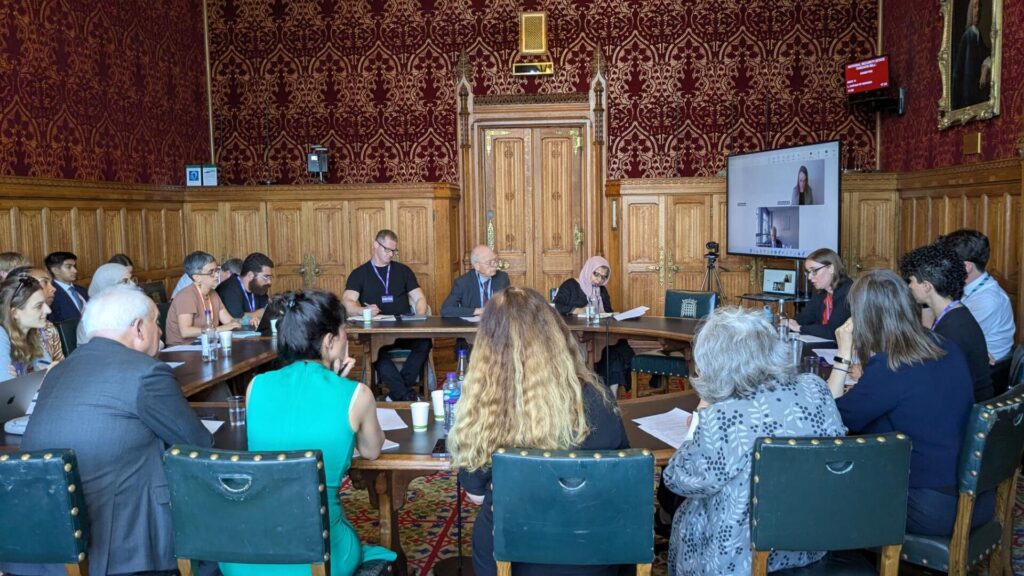
Following an introduction by chair Marcus Campbell-Savours MP, Ambassador Alexander Kmentt, Permanent Representative of Austria to the United Nations Office in Geneva, reflected on how dramatically the debate has shifted over the past decade. AWS are no longer a hypothetical future technology; they are already influencing military operations, raising urgent questions about civilian protection, accountability and international security.
Drawing on Austria’s leadership on this issue at the UN, including its role in advancing discussions towards a treaty on autonomous weapons, Kmentt argued that international humanitarian law (IHL) alone cannot address the profound human rights, ethical, security and proliferation concerns posed by these technologies. Existing legal frameworks were developed around human decision-makers and struggle to account for algorithmic systems capable of selecting or engaging targets with increasing autonomy.
As responsibility for lethal decisions becomes increasingly distributed across software developers, military commanders and automated systems, an “accountability gap” emerges, making it more difficult to establish who is legally or morally responsible. Kmentt warned that choosing not to regulate these systems is itself a political decision, and that waiting for universal agreement risks allowing a dangerous “race to the bottom” as states compete to develop increasingly dangerous autonomous capabilities. With negotiations within the UN Convention on Certain Conventional Weapons (CCW) continuing to move slowly under consensus rules, he warned that the window for preventative international action is rapidly closing.
The risks of AI-enabled warfare
Bloomberg journalist Katrina Manson provided an overview of how AI is already transforming contemporary warfare, drawing on her research into military applications of AI for her book ‘Project Maven: A Marine Colonel, His Team and the Dawn of AI Warfare’.
While these capabilities continue to advance, Manson cautioned against assumptions that greater automation necessarily produces better outcomes. AI systems remain unreliable, while military thinking increasingly risks treating human control as a political aspiration rather than an operational requirement. Manson emphasised that outdated intelligence and the scale of automated targeting systems demonstrate the risks of accelerating military decision-making without adequate safeguards.
“AI systems will not result in more precise or more humane warfare…this promise is a mirage.” Maribeth Rauh – AI Accountability Lab
Maribeth Rauh, Researcher at the AI Accountability Lab, Trinity College Dublin, challenged one of the central claims made in favour of military AI: that it will make warfare more precise and therefore more humane. Machine learning systems are trained on historical data; rather than eliminating human error, AI systems risk amplifying existing biases within datasets, while making decisions at speeds that reduce opportunities for meaningful human judgement.
Rauh also highlighted automation bias, whereby human operators become increasingly likely to trust machine recommendations, particularly in time pressured situations. At the same time, the fragmented relationship between technology companies and military users creates what she described as a “moral crumple zone”: developers often lack visibility over how their systems are deployed, while militaries cannot disclose classified operational information. As a result, no individual or institution possesses a complete oversight of how lethal decisions are made or who should ultimately be held accountable.
Why human control still matters
Elizabeth Minor, Head of Policy at Stop Killer Robots argued that the pace of technological development is now being matched by growing public concern. She pointed to heightened awareness following reports that commercial AI systems had become integrated into military decision-support tools, prompting wider debate about whether technologies familiar from everyday life should play any role in decisions over life and death.
Minor argued that preserving meaningful human control over the use of force is not simply a technical safeguard but a fundamental ethical principle: moral responsibility cannot be delegated to machines. Drawing on reported uses of AI-assisted targeting in conflicts including Gaza, she warned that automation risks accelerating violence while reducing opportunities for deliberation, restraint and accountability. The erosion of meaningful human control, she argued, increases the danger of dehumanising those targeted by military force and creates conditions in which civilian harm becomes more likely.
A critical moment for UK action
The UK Government to can take action by supporting negotiations on a legally binding international instrument to govern AWS. Elizabeth Minor noted that existing draft proposals already align closely with many UK policy positions, while stronger regulation would provide greater certainty for governments, industry and investors alike. Failure to support negotiations at the forthcoming CCW Review Conference, she warned, would effectively prioritise the interests of states seeking unrestrained military AI development, with potentially catastrophic consequences for civilian protection and global security.
The discussion concluded by turning to Parliament’s role. Participants urged MPs to exercise greater scrutiny over the Government’s position and ensure civilian protection remains central to UK policy. Several attendees suggested that the UK’s ambition to become a global leader in AI risks making ministers reluctant to champion stronger international regulation. Others argued that clear legal standards would strengthen responsible innovation by providing certainty for governments and technology companies.
The central question is no longer whether AI will transform conflict, but whether governments can establish meaningful legal, ethical and political limits before these technologies become fully embedded in military operations.