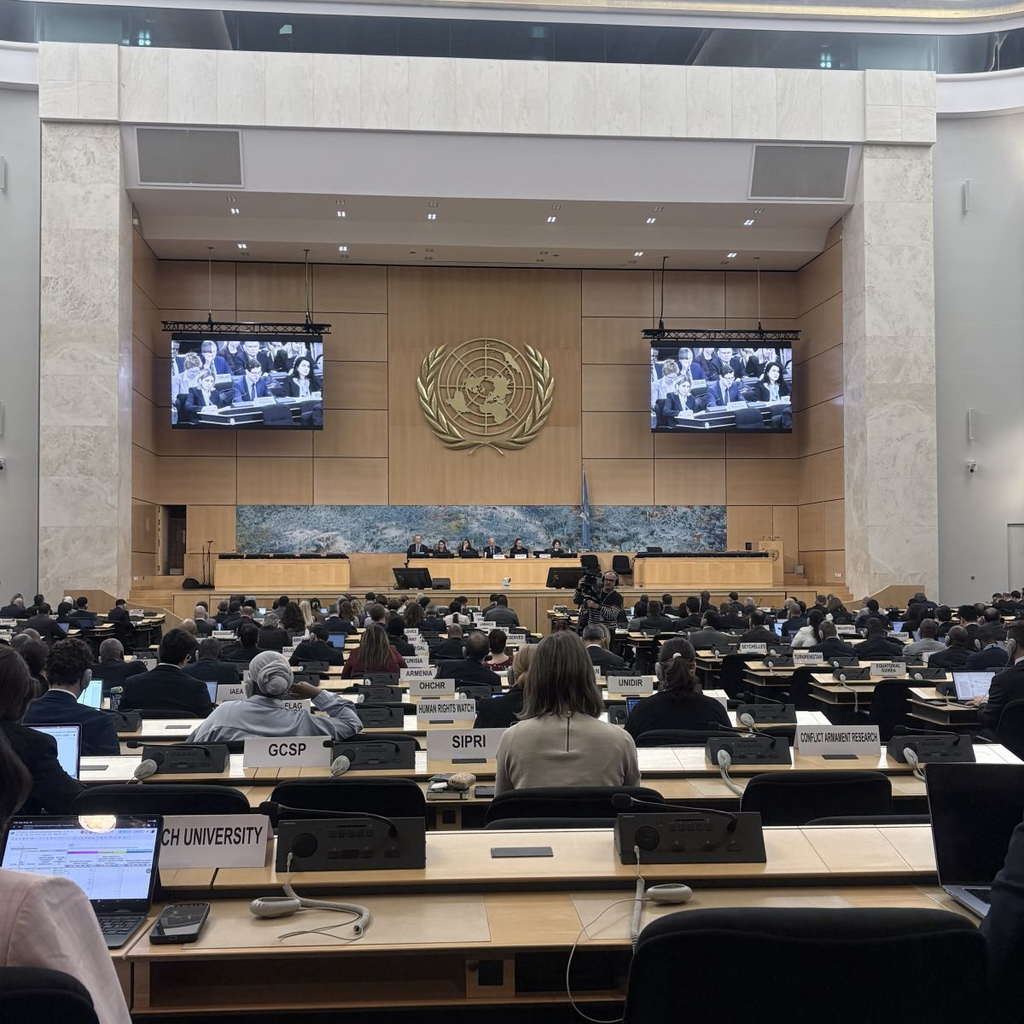
From the 16-20 November states are meeting at the UN in Geneva for the CCW Review Conference, where they will decide whether to launch a new treaty to regulate autonomous weapons system, or “killer robots”. UNA-UK Head of Campaigns, Sophie Radice, reports back on day 1.
The opening of the Seventh Review Conference of the Convention on Certain Conventional Weapons (CCW) was disrupted on Monday 16 November after Russia refused to agree to the conference agenda, causing conference president Julian Thöni of Switzerland to halt proceedings shortly after they had begun.
Russia insisted that the European Union (EU) and other observer organisations, including Stop Killer Robots and other NGOs, should be confined to making their contributions during one designated session at the end of the week, rather than being permitted to make statements throughout the proceedings.
The position closely resembled Russia’s approach at meetings of two existing CCW protocols the previous week, when similar objections were raised over the participation of observer organisations. Referring to these sessions Russia said that they had been politicised and that there had been the use of “mendacious lies”. This deliberate stalling tactic exposes the difficulties of reaching agreement within the CCW, where decisions require consensus and individual states can effectively block progress.
With the Russian position remaining unchanged, President Julian Thöni decided to proceed on the 17 with informal rather than formal talks, meaning that observers can still participate but discussions would take place outside of the formal agenda for the conference. The Russians ended the day by reminding Thöni that the informal nature of the proceedings meant that they could not be live streamed by UN Television.
Bringing together the CCW’s 128 High Contracting Parties, the conference aims to assess the implementation of existing restrictions on conventional weapons, review developments in weapons technologies and agree priorities and mandates for future work within a year long timeframe. After 10 years of work by a group of governmental experts and negotiations among states at the CCW, the UN Secretary-General has called for a treaty on autonomous weapons to be launched by the end of 2026. At the Review Conference, states have the critical opportunity to do so. While the majority of states have signalled they are ready to start negotiations, a small number are blocking proceedings.
UNA-UK is at the Review Conference in Geneva with the global Stop Killer Robots coalition to push for a new treaty on autonomous weapons systems. We’ll be following the conference closely, particularly the actions of the UK, which is currently in the minority of states who do not support new rules to regulate AI weapons.