
Governments have spent a decade building consensus on autonomous weapons. This week, in the last meeting before a political decision, that consensus is on the table.
Commentary on this week’s GGE session
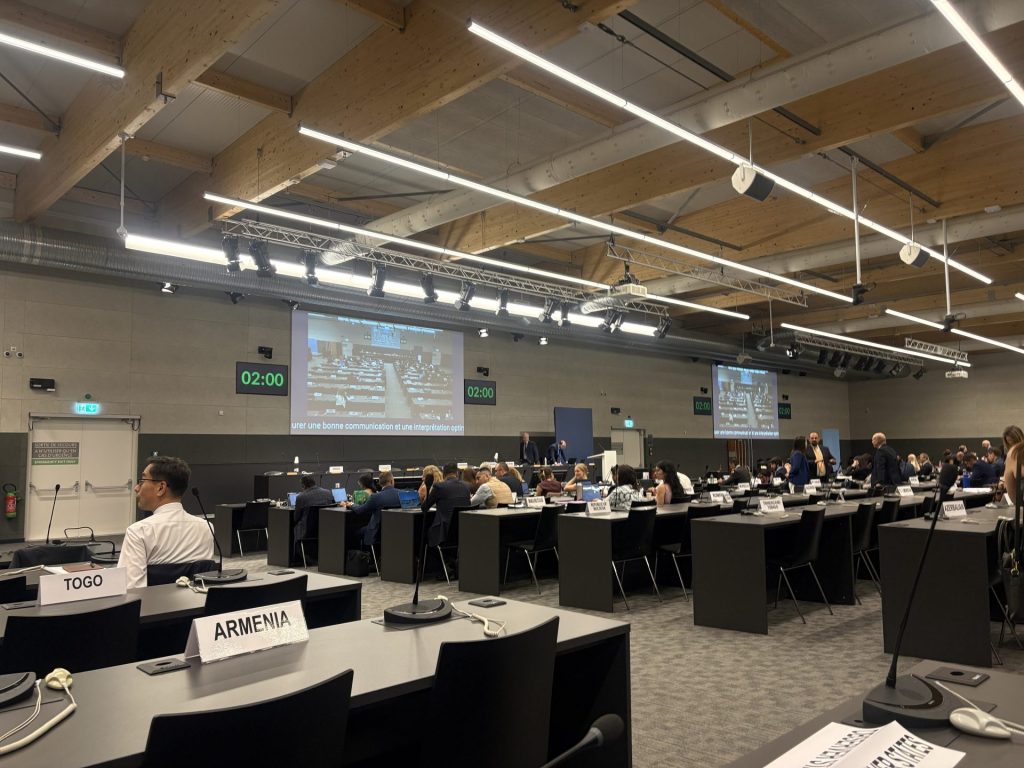
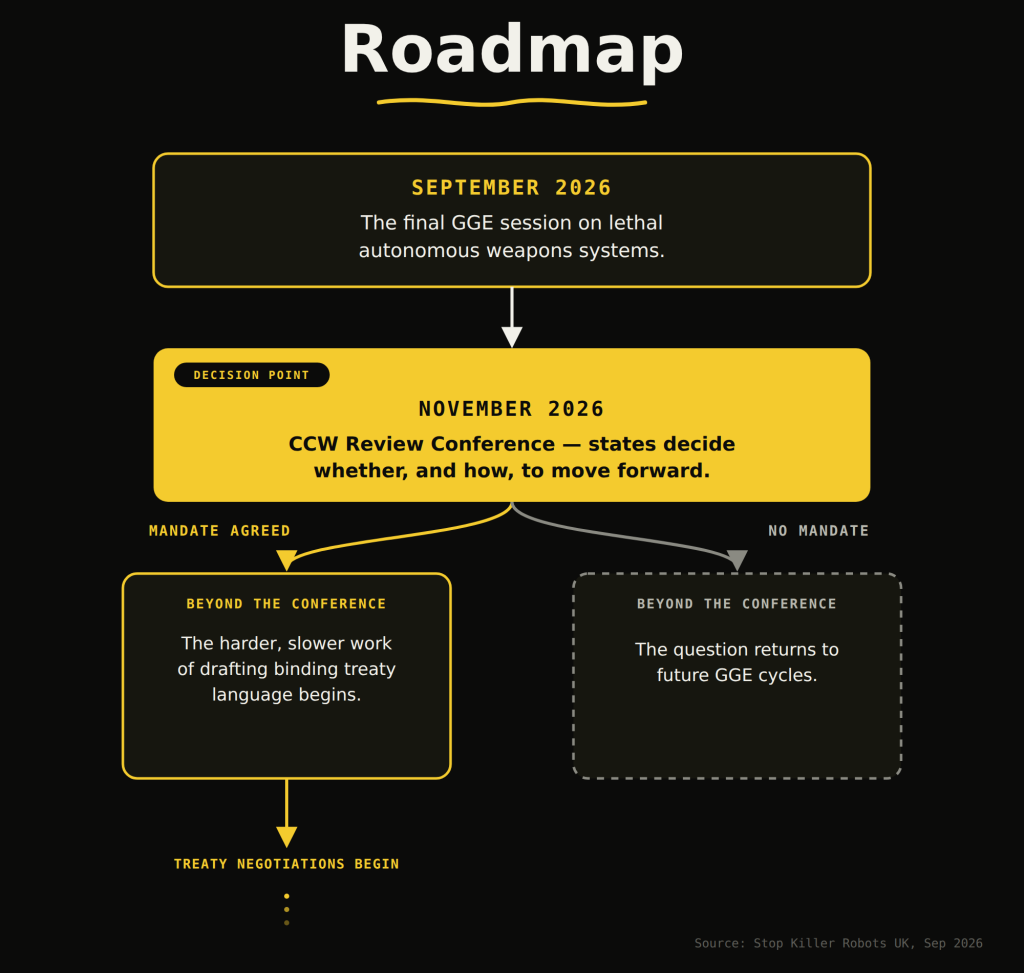
This week’s meeting of the Group of Governmental Experts on Lethal Autonomous Weapons Systems is the final expert-level session before the CCW Review Conference in November. The outcome of the Review Conference will be significant in determining whether states move towards binding international rules governing weapons systems capable of selecting and engaging targets without meaningful human intervention.
The significance of this session therefore lies less in the adoption of a new instrument and more in whether the substantial work undertaken by the GGE over the past decade is preserved and translated into a clear negotiating mandate. There is a risk that, after years of discussion, progress could be diluted through increasingly qualified language, unresolved ambiguities or a further extension of the expert process without a commitment to formal negotiations.
Ten years of drafting, comes down to one week
The GGE has operated since 2014, far longer than many of the weapon systems it discusses have existed. Over that time, a rough international consensus has taken shape around one idea, that of “meaningful human control”.
Elizabeth Minor, the Stop Killer Robots Global coalition’s Head of Policy, put the risk in blunt terms in Geneva this week: ”Governments have spent over a decade building a common understanding on how to address killer robots. Now, at the eleventh hour, some states want to water that progress down.” She stresses that the elements already on the table are “a sufficient basis to begin formal negotiations without further delay”.
“Humans, not machines, must stay in control of life and death decisions, and any attempt to weaken that principle must be rejected.”
— Elizabeth Minor, Head of Policy, Stop Killer Robots
What gives this round of talks a different texture from earlier ones is the erosion of an often used rhetorical shelter during previous sessions; the idea that autonomous weapons are a future problem, worth regulating pre-emptively but not urgently. However, autonomous and AI-enabled weapon systems are now already actively deployed in current conflicts. This includes systems described as capable of detecting and killing people without direct human control, alongside continued reports of civilian harm.
That claim doesn’t stand alone. The UN Secretary-General and the President of the International Committee of the Red Cross have jointly renewed their call for states to begin negotiating a legally binding instrument, warning that a “failure to act quickly and decisively will cost lives.”
“Human control is hanging by a thread,” Minor said. “Autonomous, AI-enabled weapons are already being tested and used on the battlefield, not someday, but right now. Delay is not neutral. It is a decision to let control slip further away. Machines must not decide who lives and who dies. That is the ethical, humanitarian, and legal red line, and we refuse to accept anything less.”
What the Group actually decides
It is worth being precise about what is and isn’t at stake this week versus in November. This GGE session cannot itself produce a treaty; its job is to protect the substance of years of drafting so that it survives, largely intact, into the political decision that follows. The real fork in the road comes at the Review Conference, where governments choose whether to convert a decade of expert-level groundwork into an actual negotiating mandate, or to extend the discussion process yet again, a move that reads as procedural patience to some delegations and as a quiet form of no to campaigners.
The metaphor campaigners keep reaching for, a fraying thread, not yet snapped concedes that human control over lethal force hasn’t already been lost, only that it is being tested by exactly the kind of quiet, incremental drift that a final negotiating session is designed to either arrest or ratify. Whether Geneva holds that thread or lets it slip is, for now, still an open question. This is precisely why this week’s session matters more than its “final expert meeting” label suggests.